
Beyond a baseline: Rethinking Australia’s Humanitarian Program
Australia’s identity is deeply tied to its history of welcoming those in need. From people displaced by the Vietnam War… Read More
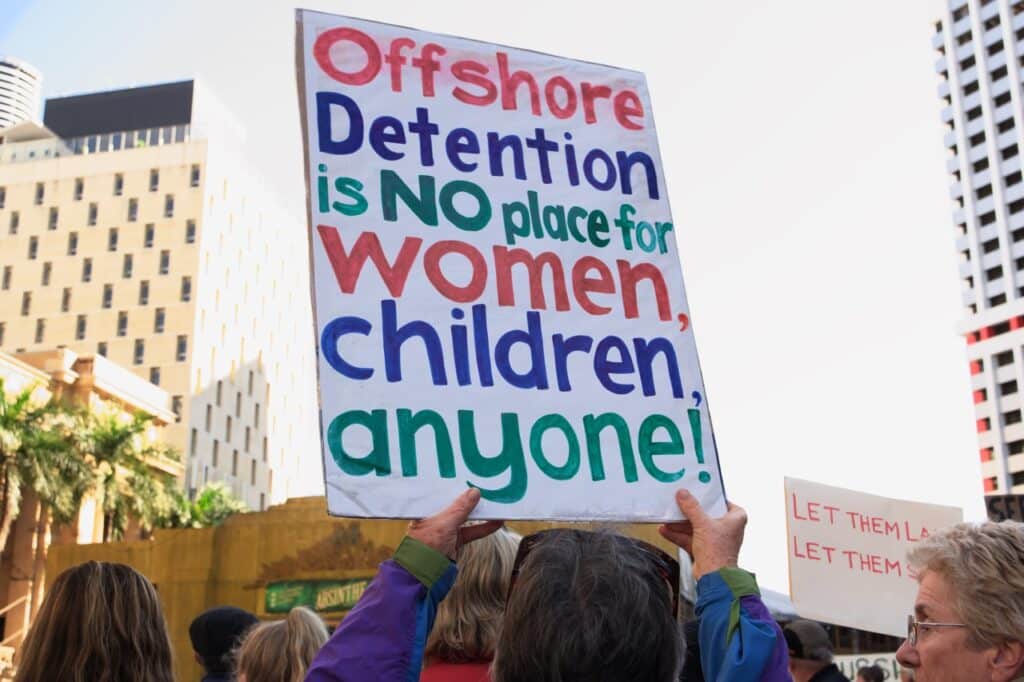
For decades, Australia has built a system of deliberate cruelty – one that governments around the world have copied. The mandatory offshore detention of people seeking asylum has long been a stain on Australia’s human rights record. Now, with similar models emerging in Europe and the US, this harmful policy risks becoming one of Australia’s most troubling exports.
In recent months, corruption allegations have emerged regarding Australia’s relationship with Nauru and the latest deal that will see Australia continue using the Pacific nation to deport people seeking asylum who the government does not want onshore.
This has prompted a Senate inquiry into Australia’s so-called offshore processing and resettlement arrangements since 2022.
However, in order to understand Australia’s current policies on mandatory offshore detention, it is important to understand the history of “offshore processing”. Offshore “processing” did not begin in 2022, nor did it begin in 2013. Its origins stretch back decades.
In the 1960s, Australia used Manus Island in Papua New Guinea to detain people fleeing West Papua. Following the Vietnam War, Australia began processing asylum claims offshore.
In 1992, mandatory detention was introduced in Australia. Then in 2001, in the lead-up to the federal election, the Howard government refused to let the ship MV Tampa enter Australia after it rescued hundreds of people seeking asylum at sea. After weeks of global attention, those people were taken by Australian forces – not to Australia, but to Nauru.
After the so-called Tampa Affair, the government introduced the “Pacific Solution,” excising islands like Christmas Island from Australia’s migration zone and sending people seeking asylum offshore to Nauru and Manus Island.
Fast forward 11 years and in 2012, offshore detention was restarted. Then in 2013, former Prime Minister Kevin Rudd announced that no person seeking asylum arriving by boat would ever be allowed to settle permanently in Australia and that his government had struck a new deal with Papua New Guinea to forcibly detain and ‘process’ people seeking asylum there.
Thousands of people were sent to detention camps in Nauru and Papua New Guinea, where successive Australian governments oversaw widespread human rights abuses. People fleeing war and persecution have been subject to harsh living conditions, inadequate food, violence, sexual assault, the denial of medical care, the denial of legal assistance and forced family separation. At least 14 people have died. Many survivors continue to live with deep psychological trauma, with widespread accounts of self-harm inside detention centres.
Since its establishment in 1993 after the introduction of mandatory detention, the Asylum Seekers Centre (ASC) has supported people who survived offshore detention and were later brought to Australia.
Sam* is one of them. After arriving by sea, he was transferred to offshore detention on Christmas Island. He described the conditions as prison-like.
“You don’t have access to anyone, it’s like a prison. It was in a container and each container has 4-5-6 rooms and each room 2 people inside. Two times a day we could come outside.”
Anna* was transferred to Nauru, where she remained for six years. She lived in overcrowded vinyl tents in extreme heat, with little privacy, food shortages and limited access to basic services. She witnessed self-harm and suicide attempts that continue to affect her mental health.
“If I remember everything, I am too stressed. I cannot sleep. Everything I remember from Nauru, I remember.
“Now if I remember, I cry too much.”
Today, around 800-900 people, including Sam and Anna, form part of the so-called “transitory cohort” and are still living in legal limbo in the community in Australia. Many live in legal limbo on temporary visas, often without secure work rights or consistent access to Medicare. Some now have Australian partners and children born here. Yet they still have no clear pathway to permanency.
In our submission to the Senate inquiry, ASC is sharing the stories of people who have survived the abuses of offshore detention. We are calling for a pathway to permanency for those living in limbo, and for an end to Australia’s cruel offshore detention regime.
Offshore detention is not inevitable. As the Senate once again scrutinises these arrangements, Australia has an opportunity to take a different path – one grounded in dignity, fairness, and respect for human rights. That begins by listening to survivors, ending offshore detention for good, and building a more compassionate future.
Read the Asylum Seekers Centre’s submission to the Senate inquiry HERE.

Australia’s identity is deeply tied to its history of welcoming those in need. From people displaced by the Vietnam War… Read More
Sydney, 12 March 2026 — Following the passage of a new law which creates powers to temporarily block travellers from… Read More
"*" indicates required fields